Drive2Gauss: FeedForward 4D Gaussian Reconstruction from Multimodal Generative Driving Videos

Tong Zhao1,2 Zhiyuan Han2 Lin Chen3 Bowen Xie4 Yunxi Qiao5 Bohan Li6 Weiqing Xiao7 Gen Li8 Shu Han9 Xuyang Dai10 Cheng Bi10 Hao Zhao1 Chaojian Li11,†
1 AIR, Tsinghua University 2 Tongji University 3 Beijing Technology and Business University 4 Fuzhou University 5 Tsinghua University 6 Shanghai Jiao Tong University 7 Nanjing University 8 Zhejiang University 9 University of Wisconsin–Madison 10 Great Wall Motor 11 The Hong Kong University of Science and Technology † Corresponding author

Demo Video

Abstract

Generating reusable driving environments requires both controllable future observations and an explicit representation that supports rendering from different viewpoints, yet existing methods still recover explicit scenes from generated RGB videos through optimization for each sequence. To overcome these limitations, we present Drive2Gauss, a feedforward framework that converts jointly generated RGB, metric depth, and dynamic flow into dynamic 4D Gaussian scenes. A Multimodal Video Generator predicts the three modalities from reference multiview images and future control signals. Furthermore, we introduce a Gaussian Query Decoder that uses depth to initialize sparse 3D queries and flow to associate the queries across time, and integrates appearance information through spatiotemporal feature aggregation and iterative query refinement. The reconstruction stage operates in a single feedforward pass without optimization for each scene. Extensive results on nuScenes demonstrate that our approach attains an FID of 6.38 and an FVD of 12.43 for future RGB generation, a PSNR of 29.91 dB when reconstructing its generated observations, and supports both direct rendering under lateral camera shifts and downstream video fixing.

Method Comparison

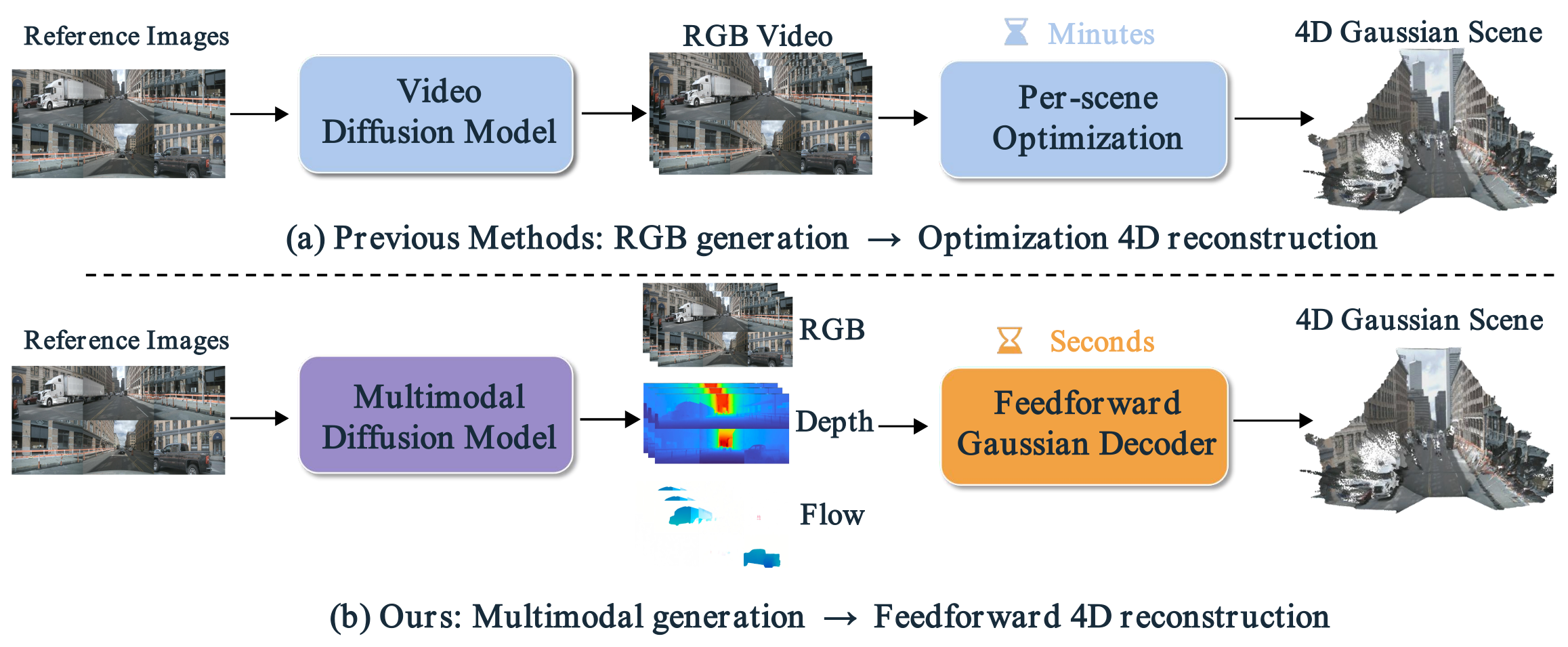
Comparison between optimization-based RGB-first reconstruction and the feedforward multimodal Drive2Gauss pipeline
Previous RGB-first methods require per-scene optimization, whereas Drive2Gauss jointly generates RGB, metric depth, and dynamic flow for feedforward 4D Gaussian reconstruction.

Method Overview

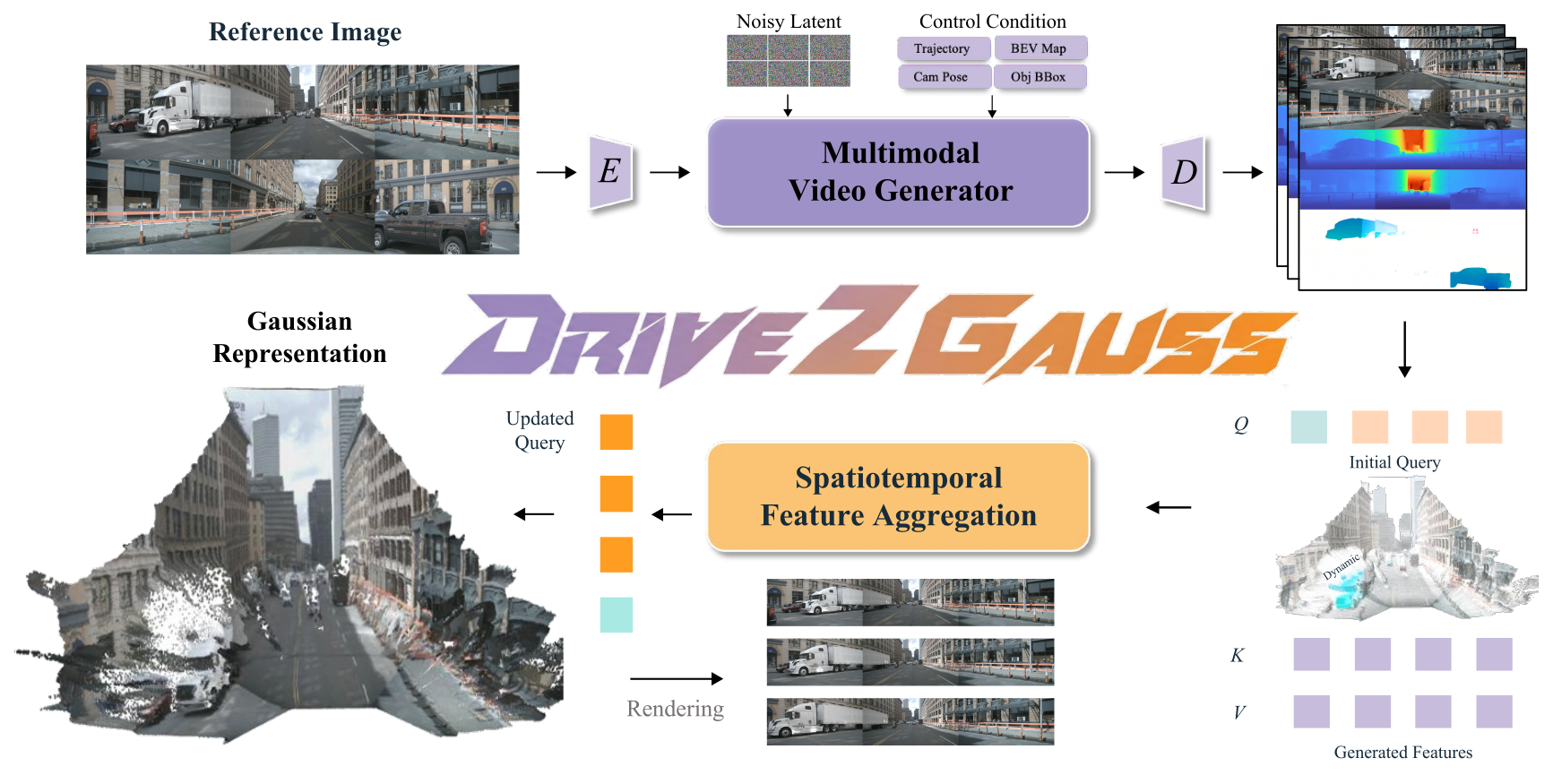
Overview of the Drive2Gauss multimodal video generator and Gaussian query decoder
Drive2Gauss combines a multimodal future video generator with a Gaussian query decoder that performs spatiotemporal feature aggregation and directly produces a dynamic 4D Gaussian representation.

Multimodal Video Generation

Joint RGB, depth, and dynamic-flow generation across six surround-view cameras.

Multimodal Dataset

Ground-truth RGB, metric depth, and dynamic flow across six surround-view cameras.

Feedforward 4D Gaussian Reconstruction

Generated observations are converted into renderable 4D Gaussian scenes in a single feedforward pass.

Novel-View Rendering

DGGT and our method render novel views from the same generated video input.

Application to Video Fixing

The reconstructed 4D Gaussian scene provides geometric guidance for restoring a degraded generated video.

Quantitative Results

Hover over a table to enlarge it.

Table I

Future Video Generation

MethodRGBDepthFlowFID ↓FVD ↓
Panacea✓××16.96139.00
MagicDrive✓××16.20217.94
Drive-WM✓××15.80122.70
WoVoGen✓××27.60417.70
Vista*✓××13.97112.65
DriveDreamer-2✓××11.2055.70
MagicDriveDiT✓××20.9194.84
UniScene✓××6.4571.94
DiST-T✓✓×6.8322.67
Drive2Gauss✓✓✓6.3812.43
Table II

Feedforward 4D Gaussian Reconstruction

MethodPSNR ↑LPIPS ↓SSIM ↑FID ↓FVD ↓
Panacea + DGGT26.230.2610.79050.24181.51
MagicDrive-V2 + DGGT28.120.2300.83068.09370.59
DiST-4D + DGGT27.760.2000.82530.1790.70
Drive2Gauss29.910.1010.88412.8532.01
Table III

Direct Novel-View Synthesis

Method±1 m±2 m±4 m
FID ↓FVD ↓FID ↓FVD ↓FID ↓FVD ↓
DreamDrive72.20381.93143.15780.71233.151271.42
Panacea + DGGT142.32664.29190.57844.70251.931085.29
MagicDrive-V2 + DGGT86.401032.22109.341241.29150.051481.17
DiST-T + DGGT53.44562.2273.55744.32107.93956.98
Drive2Gauss38.38281.2759.60605.65101.231025.44
Table IV

View Fixing

Method±1 m±2 m±4 m
FID ↓FVD ↓FID ↓FVD ↓FID ↓FVD ↓
DiST-S10.1245.1412.9768.8017.57105.29
GaussianDWM8.3644.5011.2768.1718.81116.40
WorldSplat8.2540.1711.2647.4113.3864.07
RGB-D + SPVC10.3725.9911.1930.6812.8241.29
Drive2Gauss + SPVC6.6821.257.8524.289.0035.73
Table V

Gaussian Query Decoder Ablation

VariantPSNR ↑SSIM ↑
w/o Init Flow27.890.814
w/o Iterative Refinement28.030.827
w/o Cross-Attention28.760.849
Drive2Gauss (Full)29.910.884
Table VI

Gaussian Query Number Sensitivity

QueriesPSNR ↑SSIM ↑Train Peak
Memory (GB)
Inference
Time (s)
480K28.870.811450.96
720K29.620.836671.11
960K29.910.884921.29
1200K//OOM/